HealYou: When Design Fixes the Problem, and When It Doesn't
As co-founder and sole designer of a mental health matching platform, I ran four post-launch experiments. Two moved the numbers. Two didn't.
6x growth
Sessions
1.3% → 4.15%
Conversion
75% → 55%
Bounce rate
30-second version
- Co-founded HealYou 聊心茶室 — an online platform connecting users with licensed therapists for video counseling; handled end-to-end design as the sole designer
- Two iterations worked: moved time slots onto the therapist profile page (1.3% → 4.15% conversion), surfaced the filtering form directly on the homepage instead of hiding it behind a click (-20% bounce rate)
- Two didn’t: a full homepage trust redesign (no change in dwell time or conversion), a referral program (~3 conversions in 6 months despite prominent promotion)
- The pattern: the iterations that worked were fixing friction in the design. The ones that didn’t were trying to reach something design can’t touch.
Role
Co-founder & Product Designer
Company
HealYou 聊心茶室
Year
2022–present
Platform
Web
Team
PM · Engineer · Psychologist
As co-founder and sole designer of a mental health matching platform, I ran four post-launch experiments. Two moved the numbers. Two didn’t. The split taught me something more useful than any individual result: the question to ask before designing anything.
Background

HealYou 聊心茶室 is an online platform matching users in Taiwan with licensed therapists for video counseling. I co-founded it alongside a PM, an engineer, and a psychologist — and handled all design: research, visual identity, booking flow, therapist profiles, and ongoing iteration.
Three structural barriers make people hesitate to seek therapy in Taiwan: the cost (NT$2,000–4,000 per session), the difficulty of choosing a therapist without reliable word-of-mouth, and uncertainty about whether they even need help. The platform’s job was to reduce those barriers as much as design could.
The design responded directly: a calm, tea-room aesthetic to lower the emotional cost of arrival; rich therapist profiles with specialties and approach to replace the word-of-mouth users couldn’t rely on; and a 3-step booking flow — browse, select time, pay — to remove every unnecessary decision. After launch, the interesting work began.
The question I learned to ask
After two years of iterations, one question became my filter before committing to any change:
Where does this problem actually live — in the design, or somewhere design can’t reach?
Some friction lives in the product: information in the wrong place, unnecessary steps, a UI that asks users for something they can’t give. Fix the design, behavior changes.
Other friction lives upstream: in the nature of the decision, in social dynamics, in how people actually behave when no product is watching. No amount of UI work changes that.
The four iterations split exactly along this line.
When design worked
Merging availability into the therapist profile page
“Does this therapist have a slot that works for me?” is not a secondary question — it’s the deciding factor. Session recordings made the pattern visible: users were comparing multiple therapists, which meant repeatedly navigating listing → profile → a separate availability page, then clicking back twice to return to the listing and start again. Each therapist cost three extra steps just to answer one question. We merged availability into the profile page to answer it where the decision was already happening.
Result
Profile → checkout conversion: 1.3% → 4.15%
Measured approximately one month after the feature launched.
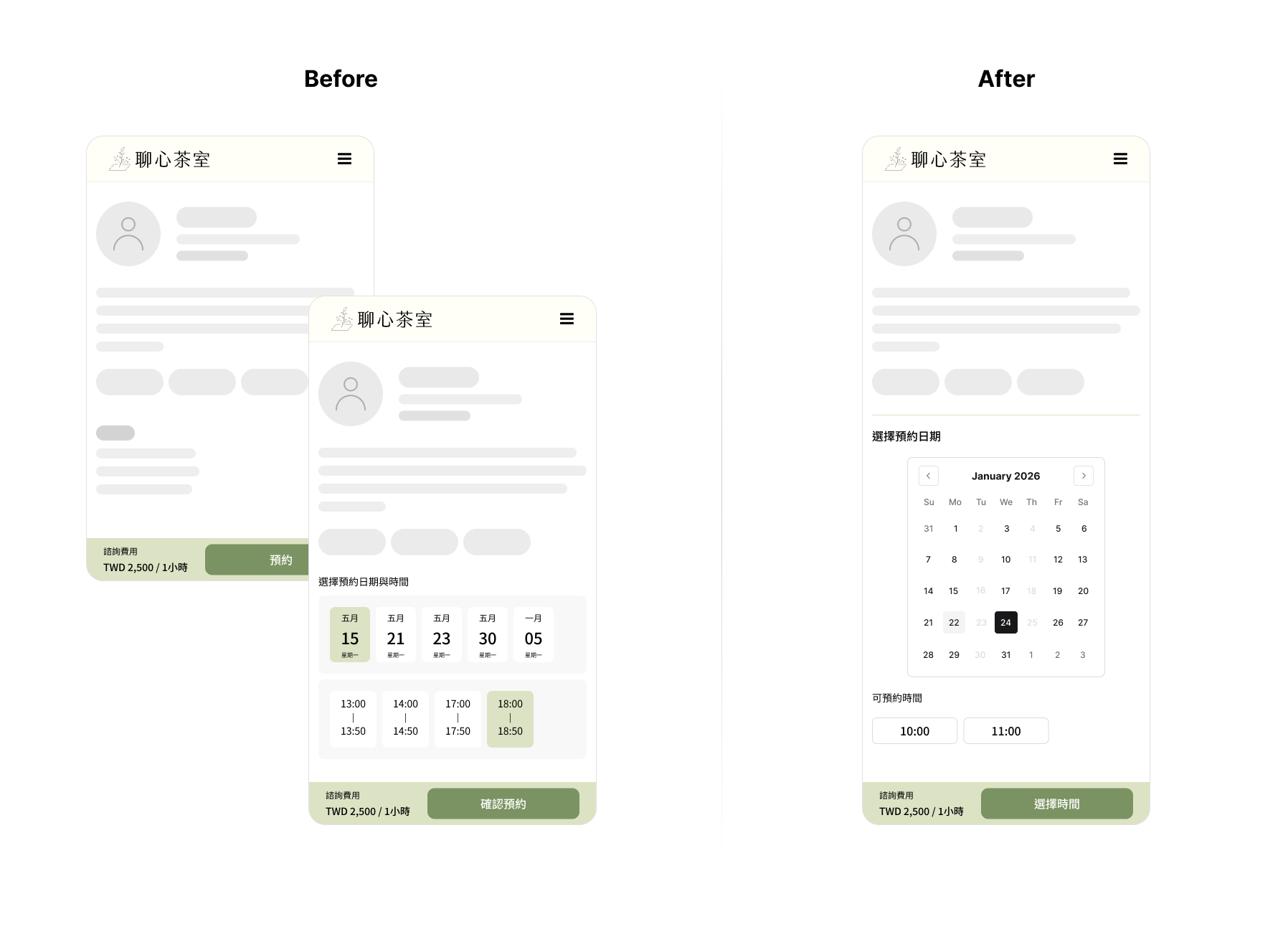
The calendar format came from a recurring pattern in user interviews — people found it easier to gauge availability when they could see the full month layout rather than a list of dates.
Surfacing the filtering form instead of hiding it behind a click
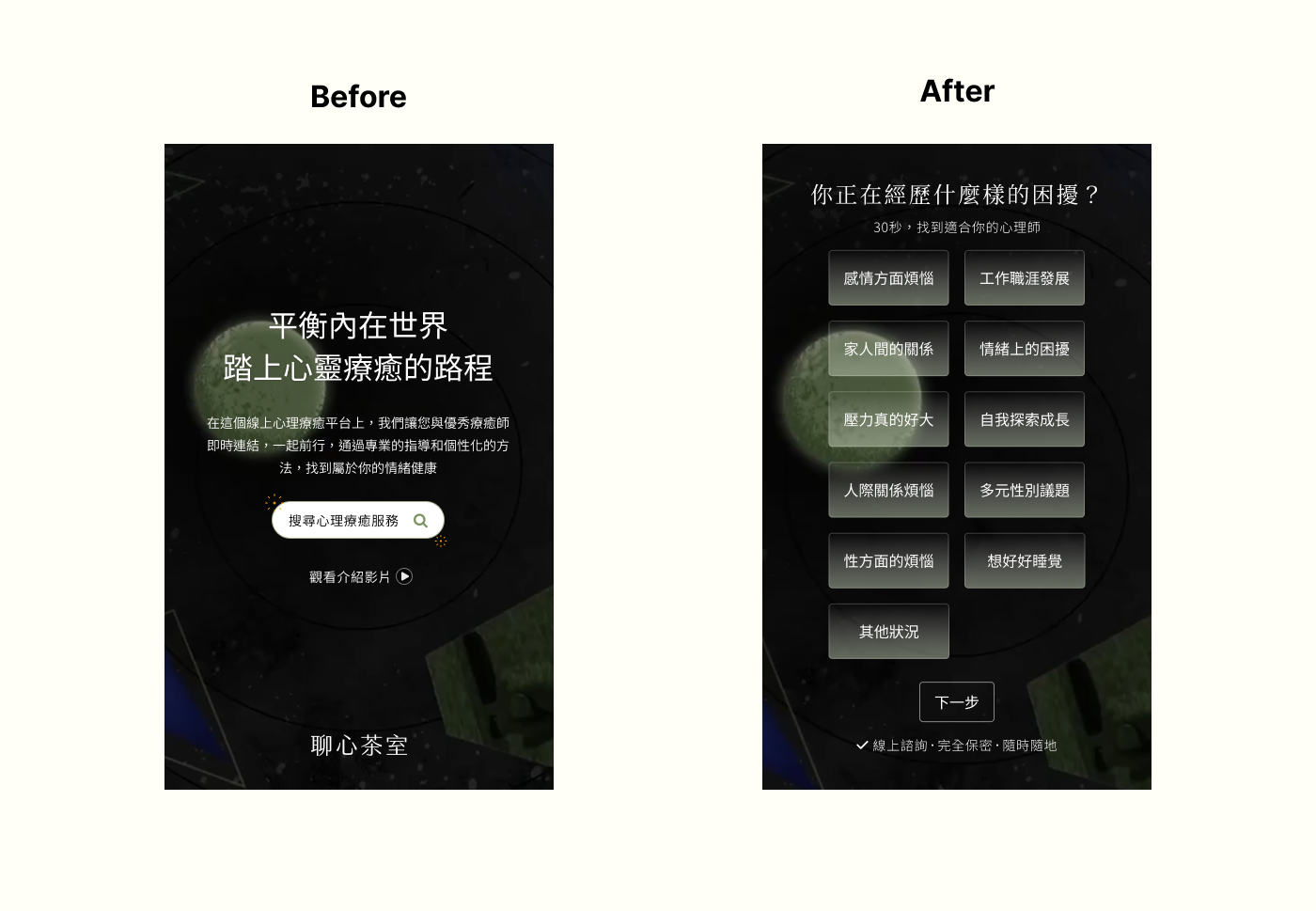
The homepage had a search-bar-like element that, when clicked, revealed a category selection form — 8 options for users to describe what they were struggling with, leading into a filtered therapist listing. The problem: most users never clicked it. Click data confirmed the low interaction rate; user interviews explained why — several users, when shown the feature, were genuinely surprised it existed. They had no idea clicking that element would open a guided matching flow.
We moved the form out of the interaction and onto the page directly, visible on arrival without any click required.
Result
Homepage bounce rate: 75% → 55%
Measured over two months following the change.
When design didn’t work
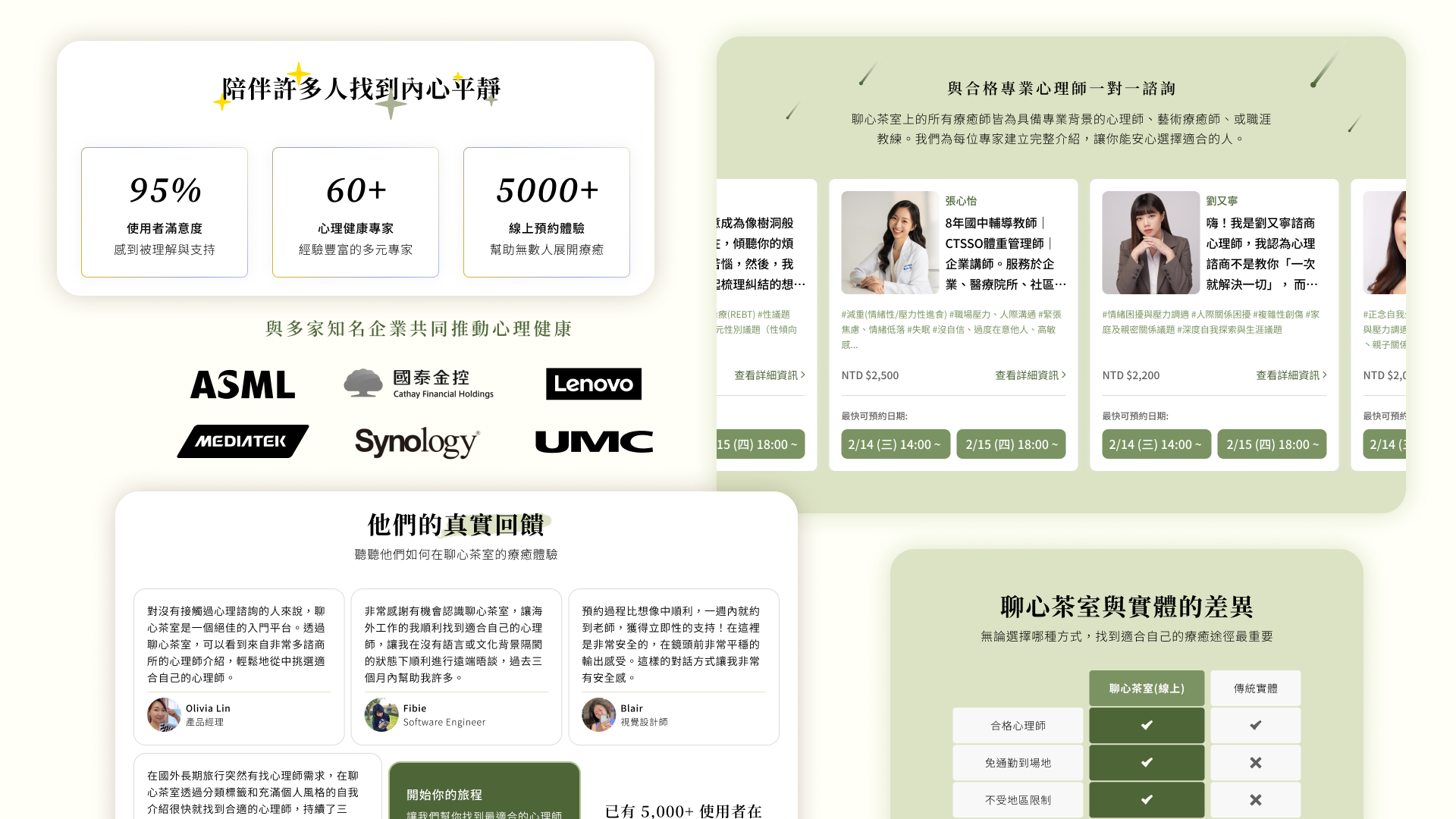
Homepage redesign — adding metrics, testimonials, FAQ
Hypothesis: visitors didn’t know who HealYou was or why to trust us. We added platform numbers, user testimonials, clearer process explanation, featured therapists with immediate availability, and a FAQ section.
Result: no significant change in dwell time or conversion.
The barrier wasn’t informational. Deciding to seek therapy is a high-stakes personal decision — shaped by years of stigma, emotional readiness, and circumstance. More social proof doesn’t move that needle. Design can make the door look more welcoming. It can’t change whether someone is ready to walk through it.
After this, the same question pointed us toward the listing page — where the friction was in the design. We had concepts ready before the business shifted focus toward enterprise partnerships, so that iteration never shipped.
Referral program — a mechanic that didn’t match the behavior
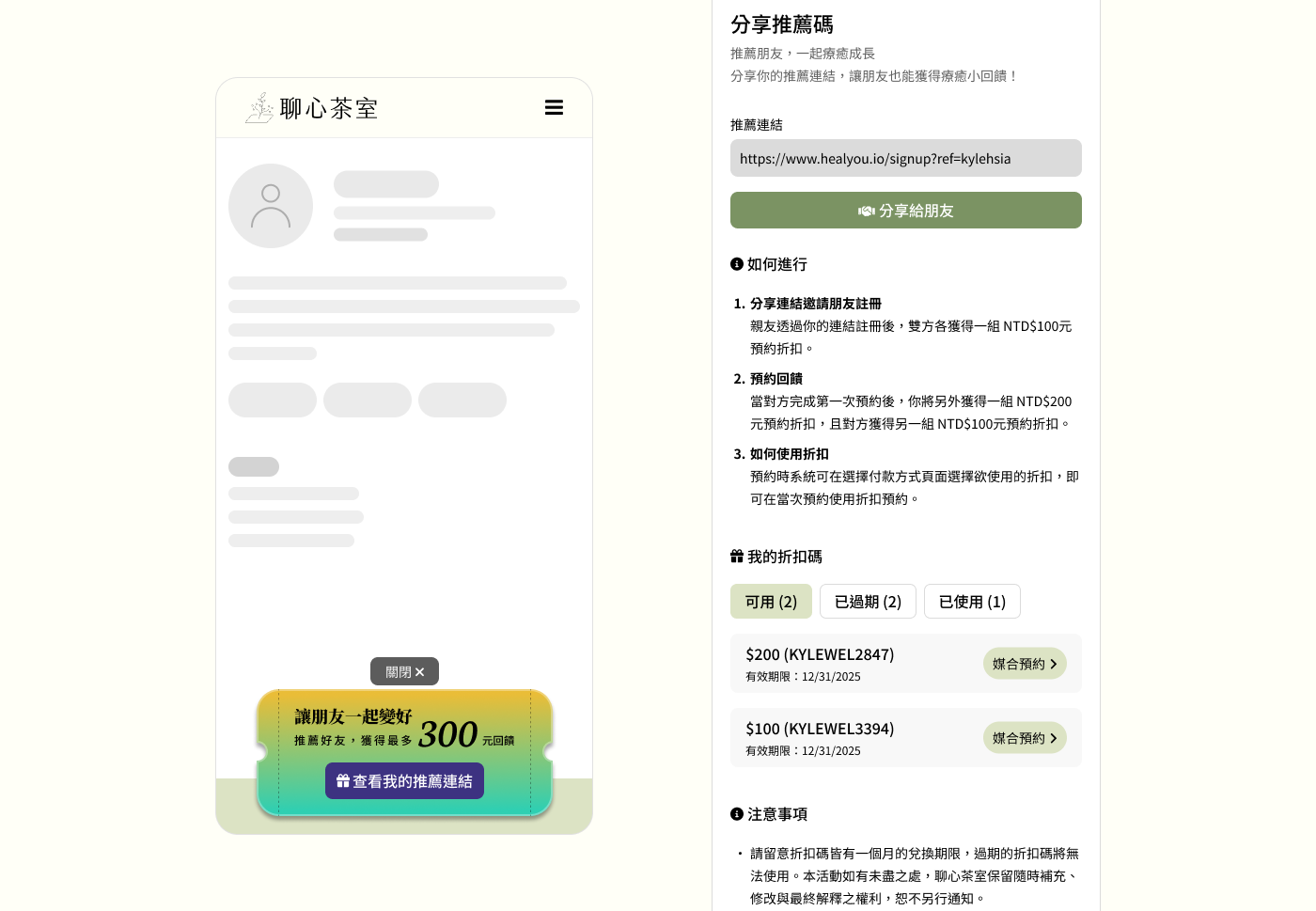
We heard that people recommend therapy to friends in crisis. We assumed formalizing that behavior — with mutual discounts and rewards — would give it a channel.
We built a referral system, promoted via a prominent mobile homepage banner.
5 months of data — October 2025 to March 2026
229
Referral page visits
12
”Copy link” clicks (5%)
5
Registrations via shared link
2
Bookings via referral code
Screen recordings showed users scrolling past the banner without pausing.
When I talked to 2–3 high-usage users: “Therapy is too private. Unless a friend directly asks, I wouldn’t bring it up.”
The behavior we were trying to formalize was reactive — it happens in conversation when someone is visibly struggling, not through a link someone chooses to share. We built a mechanic for a version of the behavior that doesn’t exist.
The deeper issue: we validated the social behavior (“people recommend therapy”) but never validated the mechanic (“people will share a link to do it”). A smaller experiment before full build would have surfaced this in days, not months.
What I took from this
The iterations that worked succeeded because the friction was in the product — move the information, remove the step, behavior changes. The ones that didn’t hit a different ceiling: the emotional weight of deciding to seek therapy, the private way recommendations actually happen. Design can build a better door; it can’t change what’s on the other side.
Running this alongside a full-time job sharpened that instinct. Every feature has opportunity cost. The referral program should have been a 3-day test, not a full build.
Before asking how to design something, ask whether design is even the right tool for this problem.